“Just Breathe”. The Story of a Military Medic Who Teaches Others to Care for Their Psychological Well-Being
Ruslana Maidaniuk, an operating room nurse with the call sign “Cheshyr”, comes from a picturesque village in Odesa Oblast. Since childhood, she has been determined, cheerful, energetic, and always smiling. Her childhood was spent surrounded by beautiful nature, filled with fun and helping her parents with household chores. Ruslana has two sisters, and recently she became the godmother of her newborn nephew. “It’s an unusual and very pleasant role for me. My nephew gives me so much strength,” she shares.
As a child, Ruslana dreamed of becoming all sorts of things, from a psychologist to a doctor. However, a little later, she realised that she wanted to become a servicewoman. She planned to pursue this path and obtain the relevant education. She eventually managed to bring these plans to life, although a little later than expected.

Ruslana initially enrolled in a college of computer technology. Just four months later, she realised that she had absolutely no desire to work in that field. She therefore decided to leave the college and wait five months until her eighteenth birthday so she could go to the military enlistment office. It was 2017, and the war in Ukraine had already been going on for several years.
“Actually, I was still a child and didn’t fully understand what was happening in the world. But I really wanted to become a servicewoman. I really liked the uniform,
and I liked the fact that it was about discipline, and that the military are the ones who stand in defence of our people. I felt that I would be very much needed there,” Ruslana recalls.
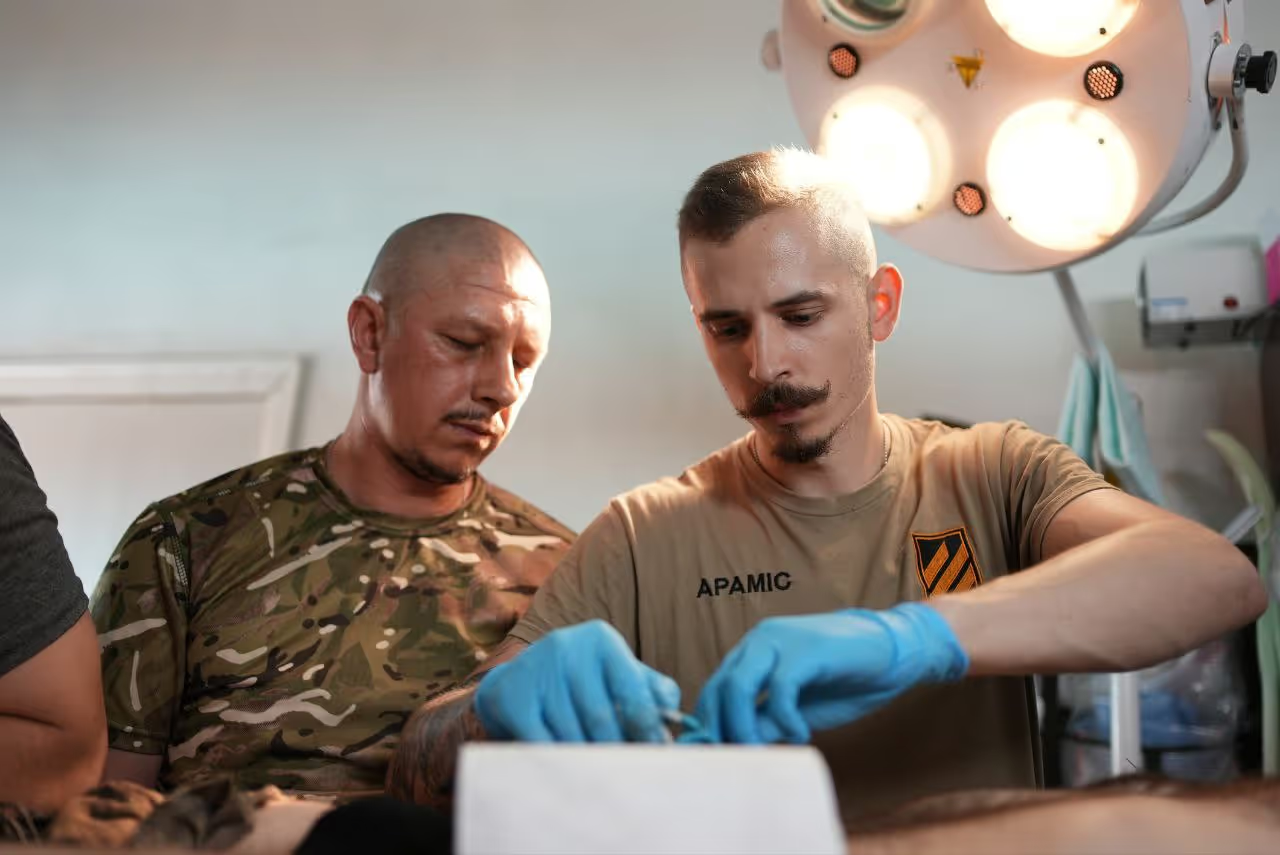
At the time, she was offered two training options to obtain a military specialisation: cook or communications specialist. “I’m not particularly good at cooking, so I chose to train as a communications specialist. First, there was basic military training, then I learned the profession itself, and afterwards I returned to Odesa to serve in the Naval Artillery. I tried very hard; everything interested me. Then, just before we were due to leave for the training ground, my commander suggested that I train as a combat medic and gain another specialisation. That was how my journey into military medicine began. That was how I became a combat medic.”

By the time the full-scale invasion began, Ruslana already had combat experience and experience providing medical assistance on the battlefield, particularly in the Avdiivka direction.
Challenges and the Demands of Service

Ruslana explains that, beyond the physical demands, working as a medic also involves psychological exhaustion. “My problem is that I always experience the emotions of the wounded myself; I take everything to heart. There was only one case when I managed to distance myself. I always say that it is useful for medics to be unemotional. Emotions must not override your reason or your actions. When that happens, I stop immediately and pay attention to myself. I really love mindfulness practices, which I discovered and began practising during Repower’s psychological recovery programme for military medics.”

“Mindfulness is the best thing there is for me. Often, your brain simply can’t take it anymore, but you gather your thoughts, step outside into nature for a few minutes, simply listen to the air and the birds, feel the ground beneath your feet, and it’s as if you draw strength from the earth and let it flow through your own body. It’s like stopping, putting the whole world on pause, and focusing on yourself. It helps a lot.”
Before joining the Repower project, Ruslana mostly lived on adrenaline, constantly expecting service-related emergencies. She explains that she often didn’t care about herself, lived only for others, and frequently ignored her own emotions and states. “That’s why I burned out while serving. But everything changed. And, of course, it didn’t happen on its own. Now I understand that if I don’t take care of my psychological well-being, I will burn out again and won’t be able to help our soldiers.”
Ruslana admits that when she was preparing to attend her first Repower psychological recovery project, she was somewhat sceptical because she couldn’t understand how it was possible to recover in just 10 days. “But during the programme, I had this WOW moment. I arrived there completely exhausted, with my head in a muddle, without dreams or goals. I didn’t know what I wanted from life; I was living only for my service.

The only thing that made me happy was that I would finally be going somewhere, because I used to love travelling. My body had travelled there, but thoughts of my patients and colleagues wouldn’t leave me. It was like that for the first few days. Then something impossible began to happen. During the project, I cleared my head and focused on my dreams, plans, and life itself. Yes, there is a war now, but sooner or later it will end, and you need to make plans and dream about your life.”

According to Ruslana, during her first project, she spent a lot of time simply being by the water. “For me, water, just like the earth, is a very powerful resource. It’s as if it clears my head. Also, before the Repower project, for about six months, I hardly felt anything other than aggression. So, during the programme, we worked on this issue with psychologists, and around the middle of the project, I burst into tears. I cried a lot; I even called my mum, and she was happy that I was crying. At that moment, I felt that I had let go of everything that had been building up for so long. I began to have goals for my future life. And, in general, I felt a strong desire to live, work, develop, come up with new approaches to my work, share things, and pass on my knowledge to my brothers and sisters in arms.”
Today, Ruslana understands better than anyone the importance of psychological recovery for military personnel and the need to work with emotions. She shares that, after the Repower programme, she became even more interested in psychology and began encouraging her brothers and sisters in arms to work on their own psychological well-being. She often shares with them the tools she gained during the programme.
According to Ruslana, sometimes the most important thing for a service member is simply to be listened to and understood. That is why she constantly encourages her colleagues not to bottle up their emotions, but to find a reliable shoulder to lean on — someone they can cry with, laugh with, and share what is troubling them.
“I remember one time when a soldier was brought to us after witnessing his brothers in arms being killed. He wanted to take his own life. Physically, this soldier was unharmed, but psychologically, he was completely shattered; everything had simply overwhelmed him. As a rule, we evacuated people in this condition because they could harm themselves or others. When we were taking him away from the positions, he was in a state of shock and, as he later admitted, wanted to talk to someone and cry. But among men, there is this idea that crying is abnormal and complaining is not okay. While we were waiting for the vehicle, I suggested that we have some tea together and eat something sweet. Eventually, I gathered the courage to ask him, ‘Why?’ To my surprise, the soldier began sharing his emotions and story with complete awareness. He said that he felt nobody understood what he was going through, so the only way out he could see was to leave this life and join the boys who had died on the battlefield.
We talked for a long time. Then he was taken for consultations with psychologists and psychotherapists, who concluded that he was completely healthy. Afterwards, the soldier was brought back to us. I remember him coming up to me and simply saying thank you. He said that what he had needed was a conversation, that he needed someone simply to hear and understand him.
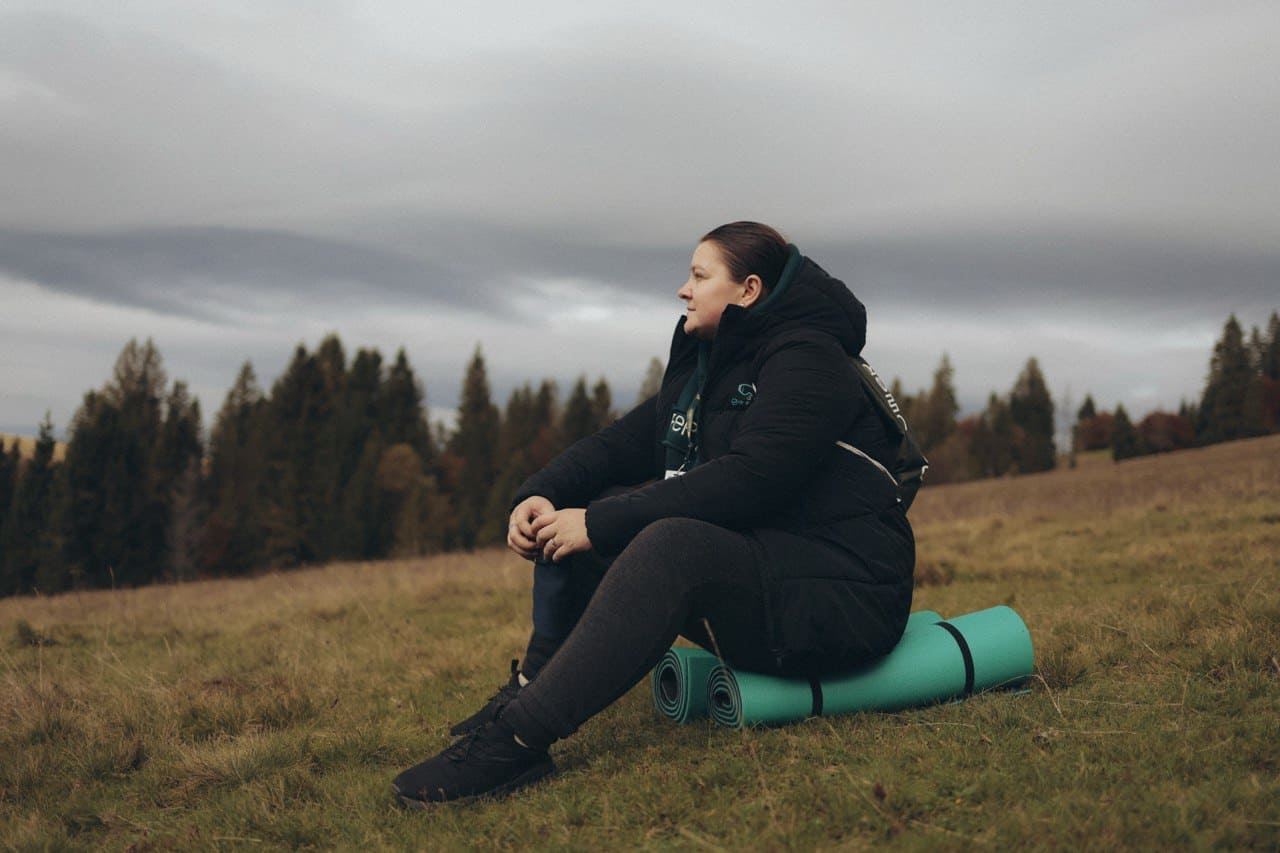
“Today, I encourage my colleagues and everyone else not to shut themselves off, to work on their own psychological well-being, and to ask for help. This story is one of many reasons why psychological recovery is important for military personnel,” Ruslana recalls.
Ruslana explains that she had gradually pieced together her understanding of the importance of working on her own psychological well-being throughout her service. However, the Repower project and working with psychologists during the recovery programme helped her organise this knowledge.
She says that she tries to be someone who knows how to listen. She also cautions that, when listening to others, it is important not to take their emotions upon yourself, but to try to preserve your own valuable resources.

Ruslana’s Favourite Practice
“Just breathe — calmly. It doesn’t require any extraordinary effort. Science has proven that calm, steady breathing is the first thing that brings a sense of calm and can help clear your mind a little. It is also about focusing on your body. This is what I highly recommend everyone do.”